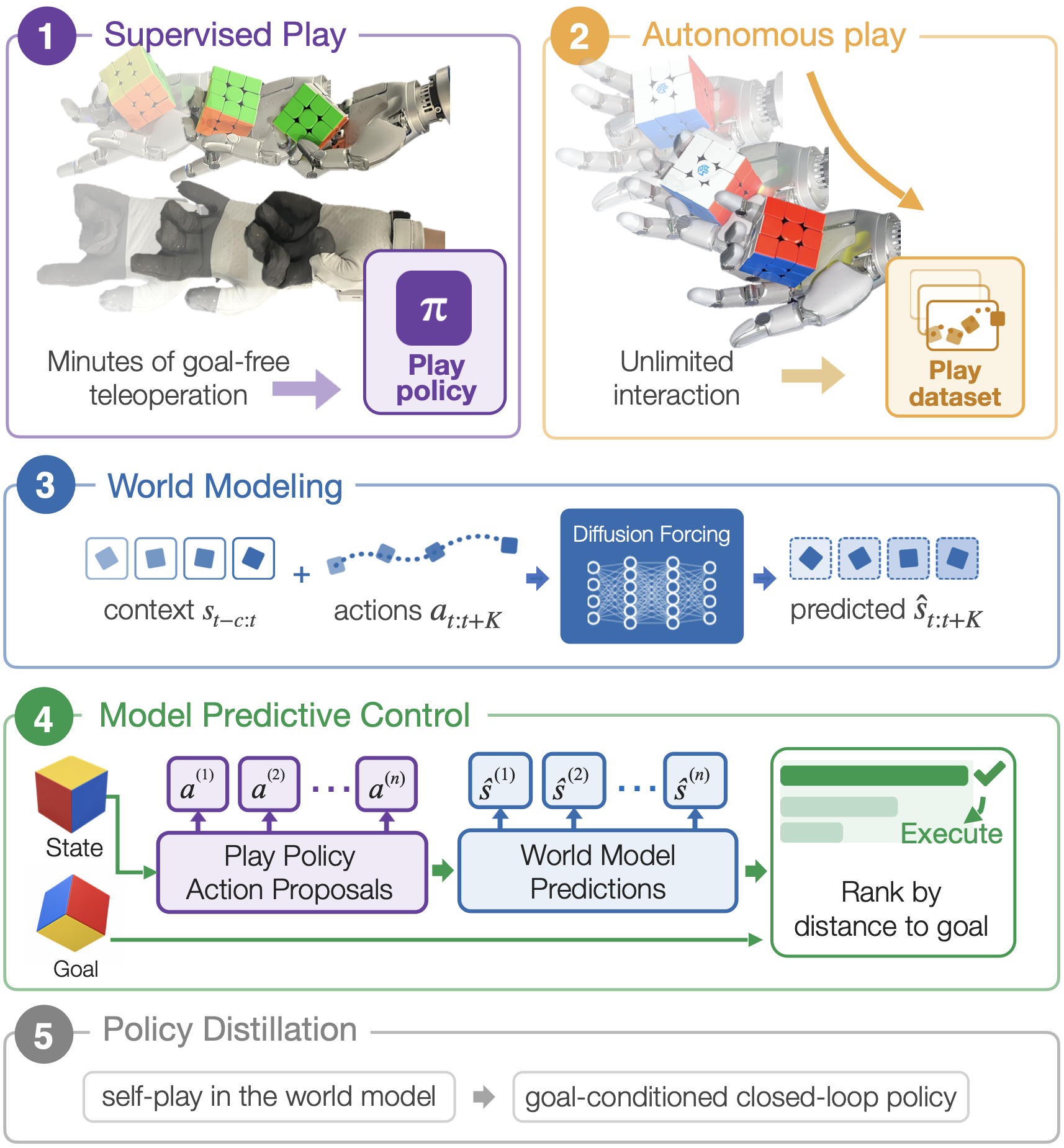
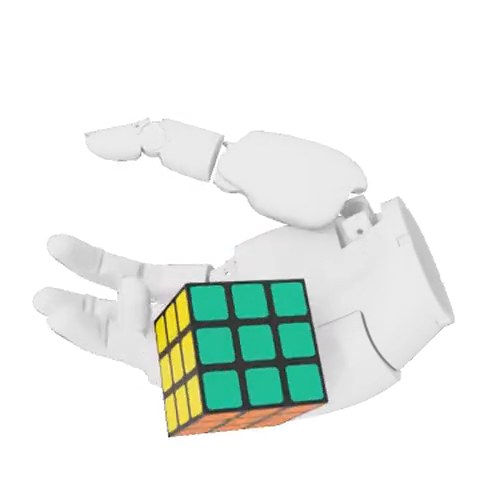
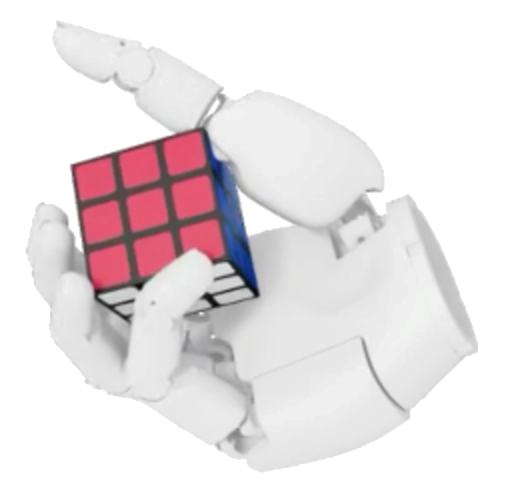
Stages 1 to 4 form DSP; stage 5 optionally distills it into a faster policy.
1Fifteen minutes of human play
Fifteen minutes of goal-free glove teleoperation train a diffusion play policy to produce 22-joint motion chunks.
data
~15 min goal-free teleoperation
policy
diffusion transformer, behavior cloning
output
chunks of 22 joint-position targets
2Autonomous play on the robot
The play policy runs autonomously for unlimited data collection.
logged
(ot, at, ot+1) transitions
scaling study
0.54 to 5.11 h
3A world model trained on play data
A Diffusion Forcing world model predicts future cube poses from recent observations and each candidate action chunk.
input
last C observations + action chunk
output
next K cube poses
training
Diffusion Forcing
tracked cube prediction
rotation error of the prediction
Use the slider to compare tracked and predicted cube poses and see rotation error across the prediction horizon.
4Planning with play proposals
At each step, DSP predicts 1,024 play-policy proposals, executes the one that gets closest to the goal, and replans; see one replan below.
proposals
N = 1,024 per replan
horizon
50 steps predicted, 25 executed (sim)
5Optional policy distillation
DSP can distill model-based planning into a 21.8 ms goal-conditioned policy that retains over 90% of MPC success at 0.8 rad.
54K recorded states × 24 goals
MPC inside the world model
1.3M (history, goal, action) labels
policy πθ(a | h, g) at 21.8 ms per step
One planning step in simulation
Three of the 1,024 proposals from a single replan, from sampling to execution.
Current statereplan from here
Sampled chunk a
Sampled chunk bclosest to the goal
Sampled chunk c
Goal
The play policy samples 1,024 goal-agnostic action chunks from the current state.
Try the loop
How DSP compares
Emerged atomic dexterous skills from play
We see this as one form of dexterity.
Yaw rotation, thumb tipYaw rotation, thumb rootEdge flipCorner flipFine adjustmentComposite
Simulation: imitation and RL baselines
Success rate on the real hand
Push-T: planar pushing from a 10k-frame teleoperation budget
With the same 10K-frame budget, DSP reaches 98% success at 0.90 overlap versus 74% for hindsight BC.
Play dataPlay-policy proposals in orangePredicted block motion in blue, selected plan in yellowExecuted plan
Planning from pixels
Object state
Ground truthPrediction · gray = truth
Object pose and hand state predict future object pose.
RGB pixels
Ground truthPrediction
RGB and hand state predict future frames.
Analysis
World-model error falls as autonomous play grows
Increasing autonomous play from 0.54 to 5.11 hours lowers 50-step rotation error by 18.8%, ending 26.4% below a static baseline.
A diffusion play policy covers more transitions
With similar imitation error, the diffusion policy covers 84.2% of transitions versus 55.4% for the deterministic policy.
Replanning takes 134 ms on one GPU
One replan takes 133.6 ms on an RTX 5090 while overlapping execution keeps control at 15 to 18 Hz.
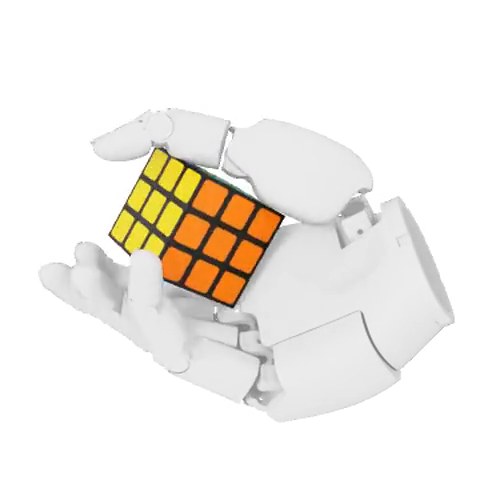
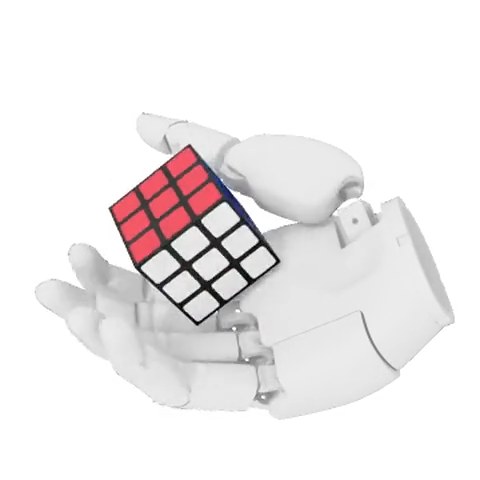
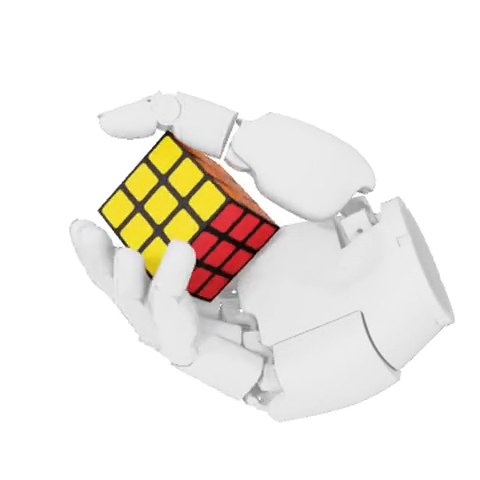
Real-world cube reorientation demos
2×
Run 1118° → 10° in 36 s
2×
Run 2136° → 20° in 53 s
2×
Run 3139° → 20° in 26 s
2×
Run 497° → 22° in 25 s
2×
Run 5162° → 21° in 48 s
2×
Run 6129° → 22° in 36 sstarts after the cube is placed in the hand
2×
Run 7141° → 17° in 18 s
2×
Run 8155° → 22° in 56 spartly sped up in the source
All clips play at 2×, with goal error and orientation trajectory shown on the right.
Questions about DSP
What counts as play here?
Play is goal-free interaction that keeps the object moving, letting behavior cloning learn useful motions without rewards or targets.
Why not demonstrate the task directly?
Play is easier to demonstrate, and with the same 15 minutes of human time DSP reaches 91.4% at 0.6 rad versus 34.4% for goal-conditioned BC.
Why not reinforcement learning?
PPO needs 344M simulator frames to reach 86.7% at 0.6 rad, while DSP reaches 91.4% with 701K frames and avoids unsafe hardware exploration.
Why use the play policy to propose actions?
The play policy supplies feasible contact motions, outperforming an equally fast orientation random walk at 0.6 rad (38.3% versus 11.4%).
Does DSP use simulation?
Not on hardware; Isaac Lab is used only to evaluate baselines in repeatable simulation.
What are the limitations?
DSP is limited by its play repertoire, requires per-step planning compute and initial human play, and has only been shown on cube reorientation and Push-T.
Could a large pretrained behavior model replace the human play?
Possibly: a pretrained behavior model could replace initial human play before autonomous data collection, but we have not tested it.
Will the code and data be released?
Yes; code, data and training details will be linked at the top of this page.
BibTeX
@misc{he2026dsp, title = {Dexterity from Supervised Play}, author = {He, Botao and Dou, Yiming and Aloimonos, Yiannis and Malik, Jitendra and Sharma, Akash and Liu, Ruoshi}, year = {2026}}